
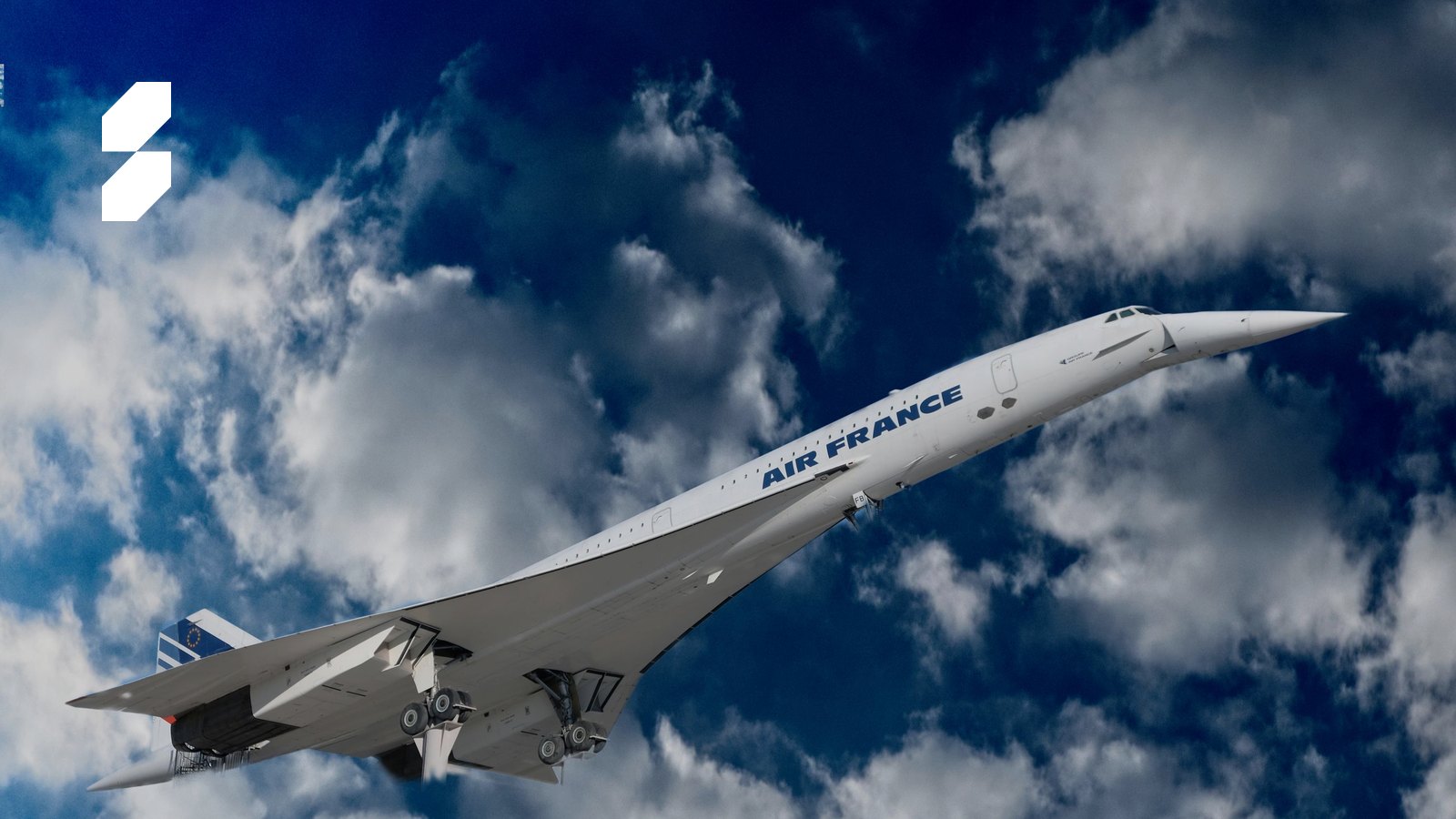
It was the most beautiful airliner ever built. A slender fuselage, a drooping nose that tilted down for landing, and a speed that let you arrive in New York from London earlier, by the clock, than you had departed. Concorde was a technical marvel. It was also a monument to one of the most expensive decision-making errors we know of.
The aircraft no one could stop
Britain and France agreed on a joint supersonic aircraft in 1962 and bound themselves to it by an international treaty. Development costs then kept rising for years and eventually exceeded the original estimate many times over. As early as 1964, a new British government wanted to pull out of the project. The treaty, however, did not allow either side to withdraw unilaterally, and government lawyers warned that France would sue Britain for heavy damages at the International Court of Justice. And so the work went on. The deciding argument was no longer whether the aircraft would pay off. It was this: we have already put too much into it.
Concorde finally began carrying passengers in January 1976. Fourteen aircraft entered commercial service. No airline wanted them at production cost, so the governments essentially gave them to their national carriers. In 2003, the aircraft were retired to museums. Beautiful machines whose only real customers were the taxpayers of two countries.
The biologists Richard Dawkins and T. R. Carlisle later made sure the story left a name behind. In an article for Nature, they named after the aircraft the error in which the next investment is decided by what has already been put in: the "Concorde fallacy". Their point still holds today: a good decision looks forward. What has been spent is spent.
The ski trip you are not looking forward to
In the mid-1980s, the psychologists Hal Arkes and Catherine Blumer showed that it takes neither a government nor an aircraft. They gave their respondents a simple scenario. You have paid for a ski trip, and then you buy another, cheaper one that you are looking forward to more. Only afterwards do you discover that both fall on the same weekend and neither can be refunded. Which one do you go on? The sensible answer is clear: the one you will enjoy more, because both sums are gone either way. More than half of the respondents still chose the more expensive trip, the one they were looking forward to less.
They then tested the same thing in real life. A university theatre was selling season tickets, and randomly selected buyers received a discount, some a smaller one, others almost half off. Those who had paid full price attended performances more often during the first half of the season. The plays were the same. The only difference was how much each person had paid for them.
The strangest finding came fourteen years later. Arkes and his colleague Peter Ayton reviewed the research and found that young children make more rational decisions than adults in similar situations. The explanation is almost touching. Adults have learned the rule "don't waste" so well that they apply it even where there is nothing left to save. They would rather keep wasting than admit that anything was wasted.
The unfinished house, the struggling business
Once you start looking around, you will see Concorde everywhere. A car you have already put so much into at the garage that you surely cannot sell it now. A degree you do not enjoy, but you are already in your third year. A company that has not made money for years, but "this time it is finally going to happen". And a house that stands as a bare shell because its owner refuses to sell for less than he has put in and lacks the money to finish it.
Sunk costs are most treacherous precisely where we made the decision ourselves and in public. Anyone who defended a project before their family, partners or bank loses more than money when they stop it. They also lose face. And so they keep pouring money in, to be right for at least a little longer.
With property, it is even harder, because the money in it is visible. The walls are standing, the tiles are laid, the windows are fitted. Every euro has a form you can touch. That makes it all the harder to admit that the market will not pay as much for it as you put in.
The question that breaks through the wall
Even professional investors are not immune to this error. They have simply learned to work around it. A good flip, that is, buying a property to renovate and sell on, has a budget, a deadline and, above all, a limit set in advance, beyond which the project stops. The decision to walk away is made at the start, while there is still nothing to regret, not halfway through, when no one wants to look at the spreadsheet.
The best tool is a single question. If I did not own this today, would I buy it at the price I could sell it for now, and would I also put in the additional money it will still cost? If the answer is yes, carry on. If not, the money you have already spent changes nothing. Only the money you are still planning to spend can make a difference.
The aircraft in the museum
Today, Concorde stands in museums in Paris, Bristol, New York and near Washington, and people have their photos taken beside it. It is beautiful. And it is a reminder that even a beautiful project can be dragged on for years after it has stopped making sense.
Walking away from something already under way is not a defeat. It is a decision that looks forward, and forward is the only direction we can still influence.